
Campus Safety
Overview
Great Bay Community College strives to ensure that all of our students, faculty, staff, and guests are able to enjoy all that the Portsmouth campus has to offer.
Campus Safety Desk
The Campus Safety desk is located just inside the main lobby where we can provide direction to all the services, classrooms, and functions within the building.
Campus Safety offers escorts to and from the building to vehicles in any of our parking lots upon request and availability. We also offer assistance with motor vehicle lockouts and jump starting vehicles. We always welcome questions about safety and security concerns.
Clery and Hazing Act Reporting
The annual safety, security, and crime information document that complies with the Jeanne Clery Act is located below.
- Annual Security Report 2025 – Portsmouth Campus (PDF)
- Annual Security Report 2025 – Rochester Campus (PDF)
- Campus Hazing Transparency Act Report 2025 (PDF)
A hard copy of these reports can also be obtained by contacting the Vice President of Student Success and Enrollment Management at the Portsmouth Campus or by calling (603) 427-7644.
These documents contain information about statistics of reported crimes that occurred on campus and on public property immediately adjacent and accessible to campus for three previous calendar years. It also has information about crime prevention, services, Campus Sex Crime Prevention Act, disciplinary procedures, and reporting policies and procedures.
Helpful Safety and Emergency Resources
Our Campus Safety Officers, faculty, and staff help ensure that the college is prepared for all hazards. Should an emergency occur, we notify the campus community to be sure that they are aware of any dangerous or threatening issues. Our Emergency Operation Plan also helps ensure that the college’s administration is able to swiftly move towards a resolution and resume normal operations as soon as safely possible following a large scale emergency or disaster.
- Anonymous Report Form
- Incident Report Form
- Concern Report Form
- Haven (Violence Prevention and Support Services)
- National Suicide Prevention Lifeline
- Community Resource Network
- Great Bay Community College Evacuation Maps (PDF)
- Consumer Information
Crime Prevention
Great Bay Community College is dedicated to a proactive approach to Campus Safety.
We believe that our community needs everyone to be situationally aware at all times. Our Campus Safety Officers are available to provide information to groups or individuals in the GBCC community about situational awareness and suggested personal safety strategies.
Below are some of the areas to be aware of:
- Be aware of your surroundings and remain attentive to people, activities and conditions around you.
- Report suspicious people, vehicles, activities, hazards or safety concerns to the Campus Safety Department immediately by calling 603-427-7697 or 911 during an emergency.
- Whenever possible, travel with others and look out for fellow members of the campus community.
- When appropriate, keep offices, classrooms, and workspaces secured when working alone.
- Report lighting outages, maintenance concerns, and hazardous conditions to Campus Safety immediately at 603-427-7697.
- If you witness someone being victimized or in distress, safely intervene when appropriate and contact Campus Safety or 911.
- Familiarize yourself with the location of campus emergency exists, AEDs, and other safety resources.
- Program the Campus Safety phone number (603-427-7697) into your mobile phone.
- Enroll in GBCC Alerts and review emergency notifications promptly when received.
- Familiarize yourself with campus emergency procedures and available safety resources.
- If you see something, say something. Report suspicious activity, security concerns, or unsafe conditions promptly.
- Whenever possible, travel with a friend or group, especially at night.
- Use well-lit, regularly traveled walkways and avoid isolated shortcuts.
- Remain aware of your surroundings and limit distractions such as excessive phone use or loud headphones.
- Keep your cell phone charged and readily accessible. Program Campus Safety and emergency numbers into your phone.
- Have your keys ready before approaching your vehicle or residence.
- Use trusted transportation options and avoid accepting rides from individuals you do not know well or trust.
- If possible, have a trusted person remain nearby until you safely enter your destination.
- If you believe you are being followed, move to a populated, well-lit location and contact Campus Safety or 911 if you feel threatened.
- Consider sharing your location or expected arrival time with someone you trust when walking alone.
- Use the GBCC Campus Safety Escort Service whenever available if you feel uncomfortable walking alone.
- Trust your instincts. If a situation feels unsafe, leave the area and seek assistance immediately.
- Ensure you are enrolled in GBCC Alerts and follow instructions provided during emergencies.
- If you feel uncomfortable entering an elevator with another individual, wait for the next elevator or allow the elevator to depart before boarding.
- If someone’s behavior causes you concern while riding an elevator, exit at the next available floor and move to a populated area or contact Campus Safety if needed.
- Position yourself near the control panel so you can easily access floor selections and emergency communication features.
- All passenger elevators are equipped with emergency communication devices. Use the emergency button if assistance is needed.
- If an elevator becomes stuck, remain calm, use the emergency communication system, and wait for trained personnel to assist you.
- Never attempt to force elevator doors open or exit a stalled elevator unless directed by emergency responders.
- In an emergency, call 911 and notify Campus Safety as soon as it is safe to do so.
- Do not pick up hitchhikers or provide rides to individuals you do not know.
- Whenever possible, travel on well-lit, well-traveled roads.
- Keep vehicle doors locked and remain aware of your surroundings.
- When stopped in traffic, leave enough space between vehicles to maneuver if necessary.
- Familiarize yourself with your vehicle’s safety features, including alarm systems and panic functions.
- Avoid stopping in isolated or poorly lit areas whenever possible.
- If your vehicle breaks down, activate your hazard lights and contact roadside assistance, law enforcement, or emergency services as needed.
- If you feel unsure, remain inside your locked vehicle until help arrives.
- If you believe you are being followed, do not drive home. Continue to a well-lit, populated location such as a police station, fire station, business or service station.
- If the vehicle continues to follow you, call 911 and provide your location and direction of travel.
- When parking at night, choose well-lit locations whenever possible.
- Lock your vehicles and secure valuables out of sight whenever it is unattended.
- Before entering your vehicle, check the area around it and look inside before unlocking the door.
- For escorts to and from your vehicle while on campus, call Campus Safety at 603-427-7697 or visit the Campus Safety Desk in the main lobby.
Most thefts are crimes of opportunity. Taking a few simple precautions can significantly reduce your risk of becoming a victim:
- Keep vehicle door and windows locked whenever your vehicle is unattended.
- Do not put identifying information on keys or key rings.
- Separate residence, office, and vehicle keys whenever practical.
- If keys are lost or stolen, promptly notify the appropriate authority and replace locks or access credentials when necessary.
- Avoid displaying unnecessary personal information in public or online.
- Study and work in well-lit, populated locations whenever possible.
- Verify the identify of visitors before granting access to secured areas.
- Report suspicious persons, vehicles, or activities to Campus Safety or local law enforcement.
- Ensure doors, windows, and locking devices are functioning properly.
- Maintain accountability for keys, ID cards, and electronic access credentials.
- Bring only necessary valuables to campus and keep them secured.
- Never leave laptops, phones, backpacks, purses, wallets, or other valuables unattended.
- Password-protect electronic devices and enable security features such as device tracking when available.
- Help maintain a safe environment by remaining alert to unsecured property and suspicious activity.
- Report suspicious activity or improperly secured areas to Campus Safety immediately.
What You Can Do
Your involvement is essential to the prevention of incidents on campus.
Disinterest and complacency are contributors to the success of crime. The burden of crime prevention rests not only with the Campus Safety Department but also with each member of Great Bay Community College. Campus Safety cannot be everywhere at once and are, therefore, dependent upon you to recognize and report incidents of suspicious and criminal activity. The extent of your cooperation will greatly influence Campus Safety’s effectiveness in maintaining a safe environment.
Doing your part means:
- Being aware of your vulnerability and following the suggestions outlined to protect yourself and your property.
- Being alert for suspicious or criminal activity and conditions that may represent a hazard to our community.
- Getting involved by becoming more safety conscious and by reporting all incidents of suspicious or criminal activity, no matter how insignificant, to Campus Safety immediately.
Remember that unreported crimes cannot be solved and that, by not reporting crimes, you allow the perpetrators to commit additional and perhaps more serious crimes. Many times crime solving depends upon how accurately and promptly the incident is reported. It is important that you be able to provide as much of the following information as possible:
- The nature of the incident.
- When and where the incident occurred.
- Number of persons involved (names, sex, race, age, height, hair style/color complexion, distinctive characteristics, i.e. facial features, scars, physical defects, glasses, clothing, etc.).
- Direction and method of travel.
- Vehicles involved (color, type, make, model, license plate number and state, distinctive characteristics, i.e., decals, bumper stickers, damage, number of occupants, etc.).
- Description of stolen property (item, manufacturer, model number, serial number, value, color, dimensions, etc.).
- Any other applicable information.
Active Attacker
An active attacker is an individual actively attempting to cause death or serious bodily harm to others. Attackers may use firearms, knives, vehicles, improvised weapons, or other means to inflict harm. These incidents typically occur rapidly and may evolve without warning.
Although these events are rare, understanding how to respond before an emergency occurs can improve your ability to make informed decisions during a crisis. In an active attacker situation, remember the core response principles:
- RUN – Evacuate if a safe escape route is available.
- HIDE – Secure your location if evacuation is not possible.
- DEFEND – As a last resort, take action to protect yourself from imminent harm.
Always prioritize your safety, call 911 when it is safe to do so, notify Campus Safety at 603-427-7697, and follow instructions from law enforcement and college officials.
What to Do in an Active Shooter Situation
If you witness any armed individual on campus at any time, immediately contact the local police at 911.
REMAIN CALM… take a few deep breaths… the most powerful resource you have is your MIND.
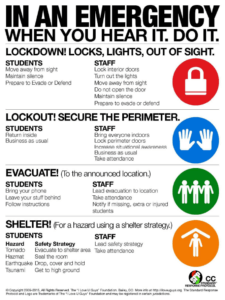
- Turn off all the lights and close and lock all windows and doors.
- Close all window blinds and curtains.
- If you can do so safely, get all individuals on the floor and out of the line of fire.
- Move to a core area of the building if safe to do so and remain there until an “”all clear”” instruction is given by an authorized known voice.
- If it is possible to flee the area safely and avoid danger, do so.
- Contact 911 with your location if possible.
- If flight is impossible, lock all doors and secure yourself in your space.
- Close all window blinds and curtains.
- Get down on the floor or under a desk and remain silent.
- Get individuals on the floor and out of the line of fire.
- Wait for the “”all clear”” instruction.
WHEN RUNNING AND HIDING ARE NOT OPTIONS
- Commit to your actions and act as aggressively as possible against the attacker.
- Recruit others to ambush the attacker with makeshift weapons like chairs, fire extinguishers, scissors, books, etc.
- Be prepared to cause severe or lethal injury to the attacker.
- Throw items and improvise weapons to distract and disarm the attacker.
- Keep hands visible and empty.
- Know that law enforcement’s first task is to end the incident, and they may have to pass injured along the way.
- Officers may be armed with rifles, shotguns, and/or handguns and may use pepper spray or tear gas to control the situation.
- Officers will shout commands and may push individuals to the ground for their safety.
- Follow law enforcement instructions and evacuate in the direction they come from, unless otherwise instructed.
- Take care of yourself first, and then you may be able to help the wounded before first responders arrive.
- If the injured are in immediate danger, help get them to safety.
- While you wait for first responders to arrive, provide first aid. Apply direct pressure to wounded areas and use tourniquets if you have been trained to do so.
- Turn wounded people onto their sides if they are unconscious and keep them warm.
- Consider seeking professional help for you and your family to cope with the long-term effects of the trauma.
- Report a suspicious looking individual or activity to Campus Safety at 603-427-7697.
- Give your location, name and reason for calling.
- Be ready to supply a physical description of the individual: age, weight, hair color and length, clothing, facial hair and any other distinguishing features.
- If the individual is in a vehicle, attempt to get the vehicle make, model and color as well as the license plate number, if possible.
- If you suspect the person is armed or see a weapon, call 911 immediately and report the situation.
- Do not approach a suspect individual yourself.
Great Bay Community College ID Card
All students are encouraged to obtain a GBCC ID Card. The card is free to all students and only takes a few minutes to get one. We recommend that you keep the card on you at all times while at the college.
The GBCC ID Card will identify you as a student at the college; and entitles you to some great benefits:
- Use it to check out books and other materials from the Library.
- Ride free on any Coast Bus.
- Use of the gymnasium and fitness center. (Waiver required)
In order to get your GBCC ID card, you will need to provide some form of identification (ex. driver’s license or passport), as well as your class schedule or college acceptance letter. They are issued at the Help Desk in room 200.
If you lose your ID card, you should report the loss to the Help Desk or Campus Safety.
You can obtain a new GBCC ID card at the cost of $10.
Parking on Campus
Members of the college community must assume responsibility for their own personal safety and the security of their personal belongings by taking simple, common sense precautions. For example, although the campus is well lit, you may feel more comfortable calling Campus Safety at (603) 427-7697 for an escort to your vehicle. Also, consider using the “buddy system” to walk to the parking lot. Vehicles should always be locked and valuables stored out of sight. Any suspicious individuals or activity should be reported immediately.
All students, faculty and staff may park their motor vehicles on campus free of charge. All vehicles parked on campus, anytime, must be properly licensed and inspected.
Students, faculty, and staff are responsible for advising Campus Safety if they are planning to leave their vehicle on campus overnight. They must leave their contact information with Campus Safety and display an overnight parking permit. The permit are available at the Campus Safety desk free of charge.
Handicapped designated parking is reserved for vehicles operated by handicapped persons. All vehicles parked in handicapped designated spots must display State handicapped license plates or decals.
Campus Safety personnel will attempt to assist with minor vehicle issues such as jump starts, lockouts, and tire changes. Campus Safety and Great Bay Community college is not responsible for losses or damages to any vehicle. If the responding Campus Safety Officer is unable to assist with the problem, they may facilitate a tow truck to the vehicle location at the requestor’s expense.
- Remember to keep your doors locked and windows rolled up when you are in your vehicle, especially when stopped.
- If someone tries to get in, drive off immediately. If this is not possible, use your horn to draw attention to what is happening.
- As you approach your car, have your keys ready. Before entering the car, check the back seat even if your car was locked.
- Consider your surroundings. Well lit, busy places are obviously the best places to park. If you have to park in a poorly lit area, or have to walk some distance to and from the car, have someone walk with you or contact Campus Safety for an escort.
- Report to Campus Safety any strange person you see lurking around any parking lot or vehicle.
- Don’t mark your key chain with your name, address, and/or license number.
- Report any tampering or other suspicious activity to Campus Safety.
- If you suspect someone is following you, drive to the nearest gas station, convenience store, or police station, and honk your car’s horn until help arrives.
- Keep valuables in the trunk, and credit cards in your purse or wallet.
- Lock your doors as soon as you enter your vehicle.
- Do not offer help to a stranded driver. Call the Police an let them know about the disabled vehicle.
- Make sure your bike is securely locked before leaving it.
- If you have a quick release seat, take it with you.
- Avoid the use of cable style locks, they can be easily cut.
- Secure your bike only to a bike rack, never to a signpost or railings.
- Do not take bikes into buildings. They can interfere with evacuation during an emergency.
- Always wear proper safety equipment while riding.